
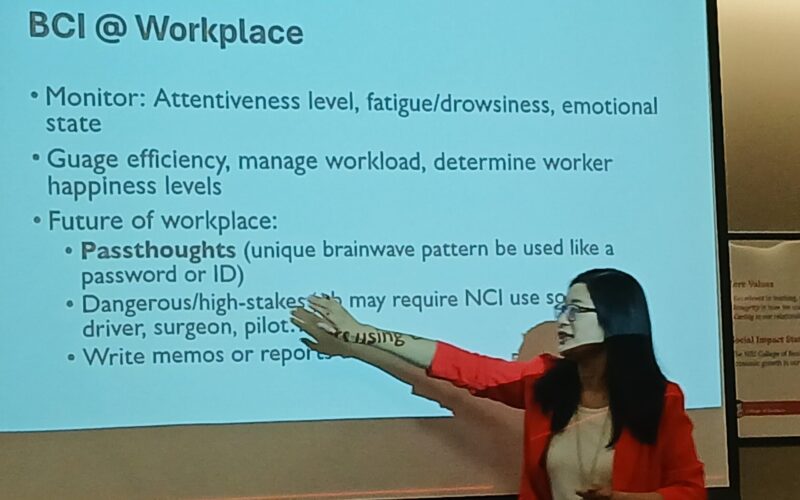
On Friday, Nov. 15, College of Business Dean Joan Phillips-Hernandez hosted a research seminar featuring Management Professor Mahesh Subramony and Marketing Associate Professor Elina Tang, who presented to fellow faculty and staff members on the topic of “Technology and the Future of Work.”
 Subramony’s talk, “From Iron Cages to Fishbowls: Welcome to the Future of Work,” discussed his research regarding changes in societal norms around employment and technological innovations. He talked about how these innovations are creating a perfect storm that is reshaping the characteristics of the work ecosystem.
“Underlying these changes are assumptions about workers, including a preference for online platforms over organizations, a sense of autonomy and control over their work, and the ability to manage their own careers. But are these assumptions consistent with facts?” Subramony said.
Subramony posed questions about what employees are giving up by gaining the autonomy of working in a more transactional gig economy or with virtual work. He explained the costs of businesses transferring responsibilities to workers and society, even as workers tend to prefer this kind of complex and paradoxical relationship.
Tang gave an overview of Brain-Computer Interfaces (BCIs) as an emerging technology and their integration into the workplace. She then elaborated on her forthcoming article, “Wired for Work: Brain-Computer Interfaces’ Impact on Frontline Employees’ Well-Being,” set to be published in the Journal of Service Management.
“My paper systematically examines BCIs as workplace technology, exploring their impact on frontline employees’ well-being and the implications for the service sector,” Tang explained, noting that her research delves into the moderating effects of various contextual and individual factors.
With the BCI market projected to reach $24.5 billion by 2027, the United Nations Educational, Scientific and Cultural Organization (UNESCO) has identified employees among the first to experience the rollout of this technology. Tang also introduced a typology of BCI devices and their applications, passing around consumer-grade examples, such as the MUSE S headband and the Emotive EPOC-X EEG headset, offering attendees a hands-on look at these innovative tools.
“I want to thank Mahesh and Elina for sharing their research and knowledge with us,” said College of Business Associate Dean Sarah Marsh. “As published thought leaders in the area of technology and how it will impact our work in the future, they gave us so much to think about.”
