
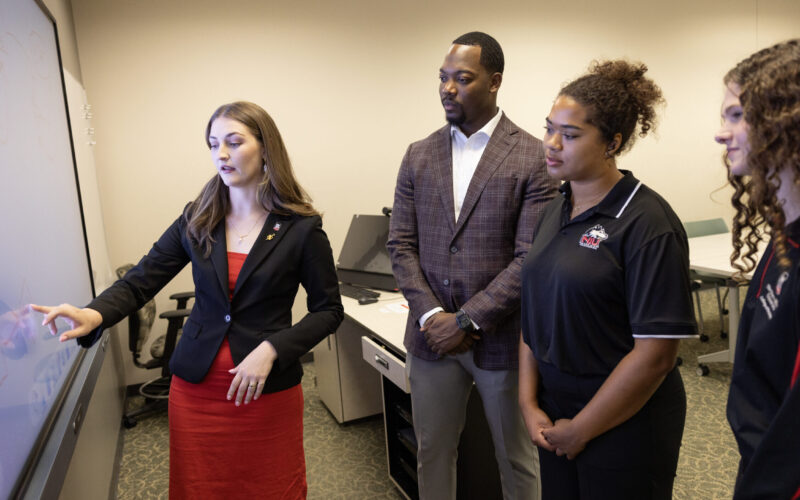
Over the summer, nearly 30% of classroom spaces in Barsema Hall, home to our NIU College of Business, were updated with innovative resources and technology. This renovation is the first in a three-phased, 18-month remodeling project, which aims to update all classrooms throughout the building — impacting all business students regardless of majors.
College of Business Dean Joan Phillips-Hernandez collaborated closely with donors, the Division of Information Technology (DoIT), the Provost’s Office, and Facilities and Campus Services to ensure this priority project could be started this summer.
 “We want the students to have a seamless experience in our building, and when this project is completed, we know that every business student will have the same top-notch experience because technology will be improved across the board, regardless of classroom or major,” Phillips-Hernandez said.
Funding for the project was primarily provided by key donors, including those to the dean’s strategic fund, dean’s technology fund and KPMG.
Thanks to the generosity of Dennis and Stacey Barsema, NIU’s College of Business moved into Barsema Hall in fall 2002. This state-of-the-art, 144,000-square-foot facility is a gleaming example of donor impact on the NIU campus.
“While many new, named spaces have been added to the building in the last two decades, this project is the first infrastructure implementation to classroom technology in 23 years,” said Associate Dean Sarah Marsh, who is a long-time management professor. “It’s great to see our classroom spaces being renewed to enable faculty to implement best practices in teaching to all of our students.”
Much of the classroom technology in the building was original equipment, including legacy VGA cabling, obsolete nondigital switching and mixing devices, and peripherals that required work arounds and constant attention to remain functional. A key decision the team had to make early was whether and how to replace legacy projectors and decided to switch to interactive flat panel (IFP) displays — a large, touch-sensitive screens that are mounted like a monitor on the wall, which have functions like a giant tablet or smart display. They combine tools like whiteboarding, screen-sharing, and collaboration software, with connectivity to computers, cameras and the internet.
“These screens are comparable in cost to a traditional projector and screen and also bring more value to our classrooms, providing new teaching and learning options to students and faculty,” said Jason Underwood, executive director of accreditation, strategy and learning, who oversaw the project for the College of Business.
Other classroom technology features included in the new designs are the ability to share content from faculty and student devices wirelessly, selecting and customizing which content is displayed where in the classroom and flexibility to use specialized devices like document cameras, classroom cameras and remote teaching technologies.
In addition to the technological upgrades, classroom furnishings were also updated in seven classrooms, with mobile, flexible and configurable furniture taking the place of old tables and chairs.
“We want to support modern active-learning pedagogies for smaller and larger groups of students,” said Phillips-Hernandez. “These pieces do configure to a lecture format, but they are ideal for more collaborative work. The default setup for these classrooms will be a collaborative model, and students will see them when they return to campus in August. This is an important step toward preparing our students to lead in the AI-ready workforce.”
 Underwood noted that getting the project through the first phase has been possible only because of the support of donors and the strong partnership between the college, The Division of IT (DoIT), Facilities Management and Campus Services, and the Provost’s office. The construction and electrical work were completed by local firms, Weaver Construction and Swedberg Electric.
“All of the teams we worked with did a phenomenal job. In particular, our talented DoIT Classroom team took on this large-scale project, designing and implementing the classroom technology infrastructure and architecture with the latest in audio-visual automation and controls,” Underwood said.
Matthew Parks, chief information officer for the NIU Department of IT, said his team hopes this renovation will serve as a model for other classroom technology updates across campus.
“DoIT is always interested in partnering with all stakeholders at NIU to drive technology innovation in and out of the classroom,” he said. “The classroom at NIU is paramount to the student experience — delivering modern technology solutions help promote optimal teaching and learning outcomes within the College of Business.”
