
By Adriana Betancourt
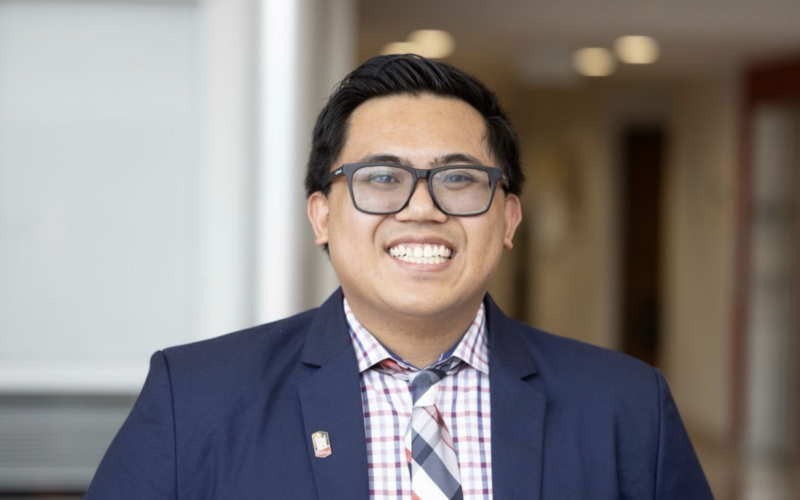
Navigating college as a first-generation student comes with unique challenges, but it can also lead to powerful growth, resilience and purpose. For Ian Rabanal, his journey at NIU’s College of Business was not defined by having all the answers but by his willingness to figure things out along the way. He learned to navigate academics, involvement and professional development through experience, support from peers and mentors, and a strong internal drive to succeed.
During his time at NIU, he became deeply involved across campus taking on leadership roles that allowed him to not only grow personally but also advocate for others. Including serving on student advisory boards and engaging with organizations like SHRM and BASA, he built meaningful connections and developed the confidence to contribute his voice in spaces that shape the student experience. These experiences played a key role in helping him discover his passion for service and his commitment to creating opportunities for others.
Now, as an employer engagement specialist for NIU’s Career Services, his perspective has shifted from navigating his own path to helping students find their own. His story reflects the growth that comes from stepping outside of your comfort zone and the lasting impact of a community that believes in your success.
Q: What’s the biggest challenge you faced as a first-generation student while at NIU?
A: I think one of the biggest challenges I faced as a first-generation student was learning how to navigate college without a built-in road map.
Having parents who never had the opportunity to attend college and being the oldest sibling, I didn’t have family members who could explain things like how to choose the right classes, build relationships with professors or take advantage of campus resources. Many of my classmates appeared to just know what to do. My family was always so supportive, but there is some anxiety with navigating new experiences and reaching out to ask for help. Eventually, I was able to figure everything out with the help of my peers, staff members and faculty members.
Another challenge was balancing responsibilities. As a first-gen student, there can be added pressure to succeed not only for yourself but for your family. That pressure can be overwhelming — especially when juggling academics, work and involvement on campus — however it is just as motivating.
Over time, challenge turned into growth. I became more proactive about asking questions, more confident in my abilities, more curious in my questions; and that’s what really drove my student experience. Experiences like working on campus, getting involved and taking on leadership roles, and connecting with faculty helped me find my way as I navigated this new adventure.
Q: Out of all your experiences, which had the biggest impact on you and why?
A: I think the experience that had the most significant impact on me was my time in the Management and Business Administration Student Advisory Board (MBSAB).
Serving on the board gave me the opportunity to act as a bridge between students and faculty, which was both meaningful and empowering. I was able to advocate for student needs, share feedback on academic programs and contribute to conversations that directly influenced the student experience. We placed a big emphasis on contributing to making the department a space in which all students felt heard, supported and empowered.
I worked alongside other driven students and faculty members, which pushed me to communicate more effectively, think critically and represent not only my own perspective, but to advocate for others. It challenged me to be more confident in professional settings.
I met some of my best friends from this organization, many of whom I keep in touch with and still see to this day. This group helped me form friendships with people I don’t think I would have met otherwise.
I like to think that the work I did on MBSAB is like my current role. In both my current role and MBSAB, I get to work with faculty members, alumni and NIU stakeholders to open opportunities for our awesome NIU students. In a sense, it’s like MBSAB was a trial run to what I get to do now.
Q: What does it mean to you being back on campus as a staff member?
A: Being back on campus as a staff member means coming full circle for me.
As a student, campus was a place where I was learning, growing and figuring things out. Now returning in a staff role, I see it as an opportunity to pay it forward and give back, and be the kind of support system that I received during my undergraduate career.
It also shifts my perspective and is eye opening. I know that every student experience is not the same, nor will it always be like mine. Instead of focusing on my own experience, I’m now thinking about how to create meaningful opportunities for students — whether that’s opening up doors and opportunities through employer engagement or helping out carry the broader work of Career Services. I am committed to being intentional in helping students feel confident, prepared and connected.
Having worked at another institution and being able to return to my alma mater is really rewarding. There’s a sense of pride in being able to contribute to a place that played such big role in my own journey. Being back on campus and in this role is not simply just a job, but a chance for me to help make a difference in helping students navigate their own paths; just like I once did.
Q: What advice would you give to College of Business students who want to build a meaningful career centered on helping others?
A: Make sure to ground yourself first and find your why. Being able to identify your core purpose/motivation gives you direction, resilience and meaning behind the work that you do. Grounding yourself with both purpose and preparation gives you the means for motivation and the tools to help you get there.
Be intentional about building relationships. Leading a career of service is very much human-centered work. You need to have the ability to listen, to empathize, to connect authentically and to be able to do that all well and intentionally will really drive your outcomes. Seek out mentors who will both challenge and support you and make sure to surround yourself with people who share the same commitment and attitude — it’s contagious!
It’s also important that you invest in yourself as an individual and be able to be an advocate for your own self-development. The work that you will carry out will require competence, resilience and emotional intelligence. You’ll be presented with opportunities that will stretch you beyond what you think you can handle, it’s important you meet the challenge head on — even when it can be uncomfortable. You know you’re growing when you’re uncomfortable because you are navigating uncharted territory.
Lastly, know your story and your experiences. Don’t lose sight of yourself. Being able to share your stories and your own experiences helps bridge the opportunity for others to connect with you. Your story and your experience help you maintain your authenticity, builds your trust in others, fosters empathy and reminds you of your resilience and purpose.
Successes in careers of service are measured by the small moments — when you have the opportunity to help someone be the best version of themself, seeing someone succeed, having someone find clarity or having them tell you that they felt supported because you were there for them.
Q: What does being a Huskie mean to you?
A: Being a Huskie means being a part of something much greater than yourself and being ready to be the change. When you join our Huskie family, you’re welcomed into a network of over 250,000-plus alumni who, from day 1, are rooting for you to succeed. You are joining a community of classmates, mentors, faculty, staff and alumni who will look out for you and show waves of support long after graduation. You develop lifelong networks of encouragement and opportunity.
You are embarking on a journey to better yourself by pursuing your higher education and ultimately getting ready to step into your career. You will become the next generation of leaders who will be striving for change, meeting others with empathy and overall making a positive impact on this world.
Learn more about Career Services.
