
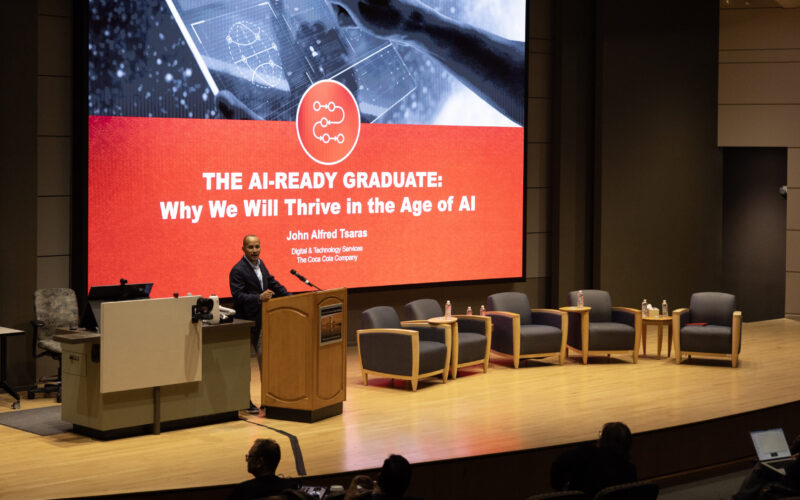
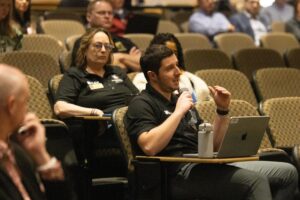
More than 60 NIU faculty, staff members and students attended our College of Business conference — “Educating the AI-Ready Graduate: An Industry Perspective” — which was held in Barsema Hall’s auditorium three weeks ago.
Attendees heard AI insights from our keynote speaker, John A. Tsaras, ’14, head of operations for The Coca-Cola Company, who discussed how quickly AI has moved from experimentation to execution.
“AI is now embedded directly into how work gets done, in finance, operations, marketing, supply chains, customer engagement, and increasingly, decision-making itself,” Tsaras said. “It is not about installing a tool. It is about redesigning work, rethinking how decisions are made, and redefining what talent looks like.”
Tsaras called this process the “new division of labor,” adding that, while AI generates insights and accelerates analysis, only humans can own the accountability and apply sound judgment to business problems.
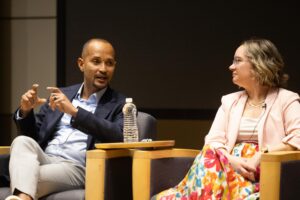 “So the question everyone asks is: ‘Will AI replace jobs?’” he said. “From inside industry, that’s the wrong question. AI doesn’t replace people. It replaces tasks. And when tasks disappear, roles evolve.”
Tsaras asked faculty and students to consider how they are preparing for leadership after graduation. In an AI-ready workforce, critical thinking is more important than ever.
“Across industries, AI is already shifting entry-level work toward analysis and judgment. It’s elevating expectations for decision-making earlier in careers and compressing time from insight to action. And it is exposing gaps in critical thinking, communication, and accountability,” he said. “And I want to acknowledge something very real for the students in this room. The early-career job market is changing. Roles are evolving. Some traditional entry points are shrinking.”
 Tsaras encouraged faculty and students to be courageous in the face of AI and strategically prepare to adapt along with AI.
“First, use AI. Learn how to use it deliberately,” he said. “Next, storytell. Build a narrative, not just a résumé. Strategy is visible in how you think. Lastly, have your reasons. Explain how you arrived at your answers, not just the answer itself.”
He also touted the importance of continued education.
“Your degree is no longer a destination. It is an operating system that must continuously update,” Tsaras said. “Now, what does that mean in practice? It means assignments that force students to show their thinking, not just produce outputs. It means scenario-based learning where tradeoffs are messy and data is incomplete. It means applied work that is non-negotiable — internships, analytics labs, corporate partnerships — so students feel the weight of real decisions before they graduate. It means moving from policing AI use to designing for it. Clear standards. Clear disclosure. And assessments that reward judgment, not shortcuts.”
Tsaras also emphasized the importance of investing in faculty the same way we expect faculty to invest in students.
Tsaras’ challenges and triumphs have allowed him to accept change and grow from it. He shared that he moved from his home country of Ghana and lived in California as a business owner until 2008 when the financial crisis “erased” his company.
 “If I wanted a future that could withstand disruption, not just for myself, but for my daughter, I had to retool. I had to reskill. I had to reinvent,” he said. “So when I arrived in DeKalb, I wasn’t starting from zero. I was starting from experience. Experience with responsibility. Experience with risk. Experience with what it means to rebuild.”
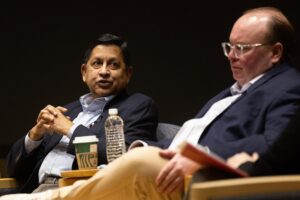
After Tsaras’ keynote presentation, Korrey Anderson, ’12, MBA ’18 (McDonald’s), Justin Gress, ’05 (Vantage Insurance) and Ram Muthukrishnan (HAVI) joined him on stage for an informal panel discussion moderated by Ann Dzuranin, KPMG Endowed Professor of Accountancy.
The group first considered the question of the entry-level job market in an AI world.
 “AI is an input,” said Anderson. “For new hires, it has an incredible value because you can just ask it any questions like you would any person when you’re starting a job, but you have to be careful because it’s not 100% accurate.”
Tsaras suggested that new hires need to prioritize design thinking along with the skills to reason and interpret what they get from AI. Also, understanding the logic and context behind an AI response is imperative to being able to trust it, as well as being able to ask AI excellent prompts that yield the response one needs.
“If students are coming to class with a ‘check the box’ attitude, they’ve already lost the point – which is curiosity,” said Muthukrishnan.
The panel also discussed ethical pitfalls that come with AI.
Anderson noted that many employees are using AI to craft performance reviews. While the process may be faster, she suggested employees and managers may be missing the positive outcomes that accompany a deeper personal reflection.
 Interviews are another area where overreliance on AI can be obvious.
“Students should know that, during an interview, it takes only two minutes to tell if an applicant is regurgitating an AI script, as opposed to having real-world experience,” said Muthukrishnan.
Tsaras added that he is concerned about the unethical use of artwork and copyrighted material when using AI. Gress noted that all of the same ethical issues we have always had in business still exist, but with AI, there are new ways to make those unethical decisions.
Throughout the conversation, the importance of cautious courage was emphasized. Faculty and students were urged to carefully go about challenging the status quo and to stay open-minded.
“A lot of the time, I hear people say they don’t know where to get started with certain issues or projects,” said Gress. “AI is a place to help you get started.”
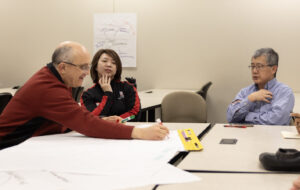
The morning concluded with breakout sessions. Faculty members worked to identify what they should adjust and keep the same in an AI-era classroom before presenting their findings to the large group.
“We need to empower communications skills,” said Accountancy Associate Professor Matt Pickard. “We can teach more prompt engineering, good design principles, context and the importance of precise communication.”
Those who attended the morning walked away with concrete ideas for improving their classrooms and a validation that cautious courage is the name of the AI game.
“It was an enlightening morning that allowed leadership to share best practices, trends and reflect on the skills our students will need as they enter the job market, and these conversations reflect who we are as a college,” said College of Business Dean Joan Phillips-Hernandez. “We are not standing still. We are leaning into AI, and that doesn’t happen by accident.
“As AI continues to reshape industries, it’s essential that we remain committed to learning, adapting and growing. This conference marked another meaningful step forward in encouraging faculty and staff to explore practical ways we can better prepare our students to be truly AI-ready,” she said.