
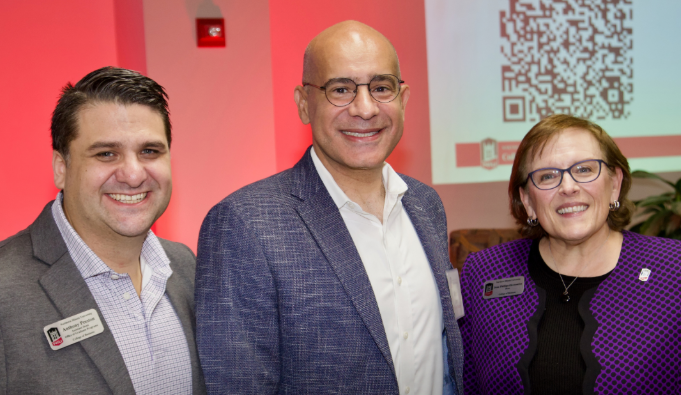
Careers rarely unfold according to plan. For Wes Saber, EMBA ’14, some of the most valuable lessons have come from moments that did not go as expected.
At last month’s NIU Executive in Residence event, Saber spoke with dozens of Executive MBA students about how mistakes, setbacks and unexpected turns became opportunities to learn, adapt and build resilience.
 In a conversation moderated by EMBA Fellow Mahesh Subramony, Saber reflected on his role as CFO of FreshEdge and his experience with companies including Haribo, Mars and Pizza Hut. Throughout the discussion, he emphasized that effective leadership requires the ability to reframe challenges, navigate uncertainty and support others through difficult moments.
“Leaders welcome bad news, and they give people support in bad times,” Saber said. “I think the key to success is switching to that breakthrough thinking and being able to have strategic agility in your thinking. We have to develop a competency for dealing with ambiguity because leaders are successful not because they have the answer to problems but because they have the right mindset to deal with those problems.”
Building strong relationships and addressing conflict constructively are equally important, he said.
“If you avoid conflict, that breaks trust,” he said. “Being able to have constructive conflict management actually builds trust in a team.”
Saber described honest feedback, both positive and negative, as one of the greatest gifts of his career. He actively seeks it out to better understand himself and grow as a leader.
“It’s hard to get feedback,” he said, “but it’s much better than getting no feedback. I try to hold people I work with accountable for my success and actively seek out their feedback. Once you get it, you can take it and say thank you or you can leave it. The easiest feedback to accept is irrelevant or not true. But you have to be careful because if someone gives you feedback and you don’t use it, they may not give it again.”
 Mentors have also played an influential role in his development. Saber distinguished between coaching, which provides feedback, and mentoring, which creates space for deeper reflection and discovery.
“Coaches give you feedback. A mentor is a thinking partner who helps create an environment where I can succeed while learning about my hidden strengths,” he said. “I’ve had eight mentors in my life, and seven of them I ‘hired’ myself. I introduced myself, asked them if we could talk and they have made a real difference to me.”
Drawing on his time at Haribo, Saber illustrated how strategic thinking can turn a perceived disadvantage into an opportunity. In 2015, he explained, Haribo led the candy market in Germany but was not among the top 10 candy brands in the United States. Rather than follow the U.S. market’s preference for sour, soft candy, his team emphasized Haribo’s distinctive sweet flavor and firmer texture. The strategy helped the company carve out a stronger identity and triple its U.S. sales over a decade.
“We knew we could create that market and own it,” he said.
Saber was equally candid about a costly setback: relocating a production line to Egypt during the COVID-19 pandemic. The experience reinforced the importance of recognizing mistakes and responding quickly.
“At Haribo, we moved an entire line operation to Egypt during COVID, and it was a complete failure,” he said. “We were moving machines, and it took almost a year to make the line operate fully again. It would have been better to build a new line. But, ultimately, making mistakes is a sign of an environment of trust. Once you make a mistake, you have to pivot. What we’re doing is not working, so we have to move fast to right the wrong. The faster you can do that, that’s resilience.”
Saber credited NIU’s Executive MBA program with strengthening his entrepreneurial mindset and helping him remain adaptable as circumstances change. His closing advice underscored the value of clear strategy, practical execution and simplicity.
“The strategy you want to go with is the sharpest strategy and the one we can actually execute on,” he said. “The ability to execute the plan is more important than the idea. And simpler is better.”
Learn more about NIU’s Executive MBA Executive in Residence series.
