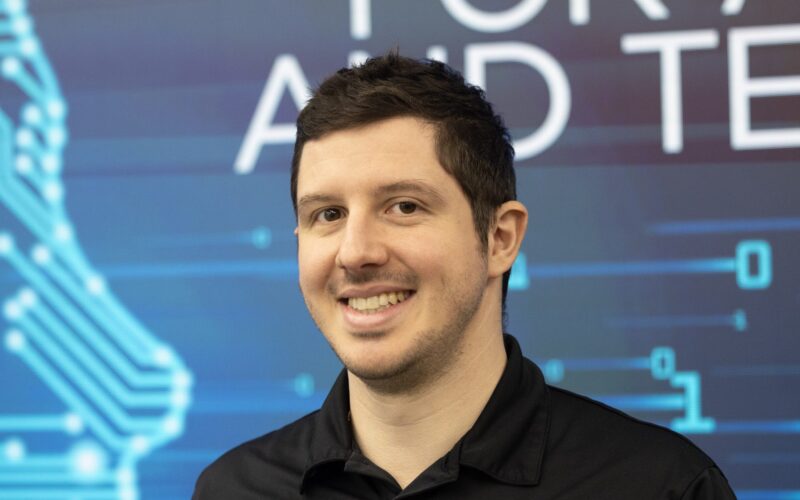
Necessity sparks invention, and OM&IS Associate Professor Biagio Palese knows that better than most. He was recently recognized with the university’s 2026 David W. Raymond Award for Use of Technology in Teaching after improving student success with a unique technological solution.
“It is truly an honor to receive this award, because technology and teaching are among my dearest passions,” Palese said.
For Palese, the innovation in OMIS 482 and OMIS 681 began with a pattern he could not ignore. The students who looked defeated by coding had not actually reached the code yet. They were defeated by barriers standing in front of it.
“Every semester, students arrived anxious about coding,” he said. “Within the first two weeks, a significant number would start to disengage, not because the material was too hard but because they could not get the software running. Package errors, version conflicts, dependency mismatches, underpowered laptops, operating system incompatibilities were all to blame. The content had not even started, and students were already deciding that coding was not for them. That bothered me deeply, because I knew it was not true.”
Existing tools did not solve this challenge, and the ones that worked reliably would have cost the students. Free apps did not permit Palese to teach the way he wanted to, so he decided to build his own solution.
“Using R, Quarto and WebR, I designed and built a custom learning environment from scratch that runs the full R engine inside the student’s browser,” he said. “It executes on whatever device the student already has: a laptop, a Chromebook, a tablet, a computer in the library, even the phone in their pocket. There’s no installation, no account, no license and no setup. A student clicks the course link and is writing working R code within seconds. And because it runs on a phone, they can practice anywhere at any time.”
Delivered as a static site through Netlify and built entirely on open-source software, the course carries NIU’s zero-cost course designation, which means it has no textbook to buy, no software license, no lab fee and no subscription. It is one of the few zero-cost technology courses in the College of Business, and nothing about the rigor was traded away to get there.
“Beyond the environment itself, I built an automated feedback engine that evaluates student code the moment it runs,” he added. “It evaluates the code against criteria written for each exercise. It not only evaluates whether the final output matches, but it is capable of awarding partial points and offering encouraging words. A student working at 2 a.m. on a Sunday gets the same immediate, substantive feedback as a student working on a Tuesday afternoon. It does not replace the conversation we have in office hours, but it means no student is ever stuck and waiting.”
Palese also rebuilt the assessment from the ground up.
“Skill tests put students in a timed, live coding session that mirrors a real technical interview, so they finish the course having already done, under pressure, exactly what an employer will ask of them. Every design decision came back to one principle: The way I deliver a course should never be the reason a student gives up on themselves,” he said.
The results were obvious in two ways: what students believed they were capable of and what they could actually do.
“The first change was also the fastest. The anxiety dropped away,” he said. “The two weeks I used to lose to installation problems are now two weeks of students discovering they can do this. Watching someone run their first line of code, see it work and get instant confirmation that it worked is something I will never get tired of. That is the moment a self-limiting belief starts to dissolve.”
Students describe the same shift in their own words.
“The [learning platform] is amazing. It really allows us to practice and develop our coding skills,” said Paige Shinberg, who earned her MIS degree in May. “I really liked the feedback system. I felt like it gave me a deeper understanding of the code because if I knew something was off, it forced me to analyze my code further to understand what was wrong. When you are forced to diagnose what’s wrong, it gives you a deeper understanding of how to do it the right way.”
Shinberg also went on to add that, while she is always driven by maintaining good grades, she felt the delivery and format this class provided something more fulfilling that a high GPA.
“This class was one of the best classes I have taken at NIU,” she said. “Having a professor care so much about my overall understanding of the content has been so much more valuable than seeing an A. I really feel like I grew from this course and will be a better professional as a result.”
By the end of the semester, Palese noted that students were writing code from a blank file under live interview conditions, with a cheat sheet and documentation open in front of them, exactly as a working coder would have. The cheat sheet was a deliberate choice because taking memorization off the table allowed for prioritizing genuine understanding.
“The goal was always problem-solving, critical thinking and a real understanding of code as a way to communicate with a computer,” he said. “Grades were never the target. Learning and mastery were. That distinction matters enormously when they walk into their first technical interview.”
The proof of his teaching methods arrived in Palese’s inbox. Several graduates have written to Palese to say they were given a live coding assessment during an interview and that his course was the reason they walked in prepared rather than panicked.
“Some have landed roles as data analysts and data scientists,” he said. “Others came back asking for independent study because the course ignited a curiosity they did not know they had. What moves me most is hearing from a student who never considered a career in analytics before this class and now cannot imagine doing anything else.”
“That is not just a learning outcome. That is a life trajectory that has changed. And to me, that is what teaching is for and what makes all the effort worth it.”
The platform has run in its full form since fall 2025, refined across two semesters and roughly 150 students. Palese built it the way he does his research — iteratively. So, he tests each version with real students and rebuilds parts from what they revealed.
This summer, Palese continued working on this experiment, this time building a custom solution in Python, so that students arriving in OMIS 324 in the fall would meet the same zero-barrier start.
Learn more about our OM&IS program.
