
As AI rapidly transforms the marketing profession, teaching students to use it strategically, ethically and effectively is becoming an essential part of a modern marketing education.
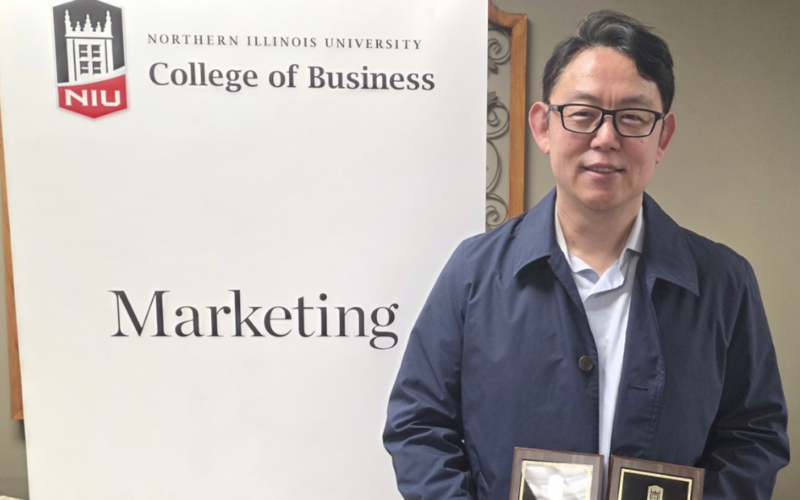
Associate Professor in Marketing Andy Jeon embraces this massive responsibility, and it shows through his hands-on approach in the classroom. He was recently recognized with the university’s 2026 David W. Raymond Award for Use of Technology in Teaching for weaving ethical and effective AI usage into his courses.
Jeon has spent years working on what he called his “AI Cognitive Amplification Project,” which focuses on designing marketing education in a way that helps students use AI as a cognitive amplifier rather than as a substitute for thinking.
“In my AI-focused courses, including MKTG 462 AI Applications in Marketing, and MKTG 662 AI in Digital Marketing, I emphasize that the quality of AI output depends heavily on the quality of human input,” Jeon said. “Students are not simply learning how to use AI tools. They are learning how to think with AI, how to ask better questions, how to evaluate AI-generated outputs and how to use those outputs to strengthen their own creativity, analysis and strategic decision-making.”
The project has three main objectives:
- To help students understand how AI systems work conceptually, strategically and ethically.
- To use AI to expand students’ creativity and problem-solving capacity.
- And to create a scalable, code-free or “code-accessible” AI curriculum framework that removes technical intimidation while preserving analytical rigor.
“I believe it is important because students are entering a world where AI and related technologies are becoming part of everyday professional work,” Jeon said. “However, simply giving students access to new technology is not enough. They need to understand how the technology works, where it can fail and how to use it responsibly.”
In his courses, Jeon tried to prevent “cognitive surrender,” in which people passively outsource their thinking to AI.
“Instead, the classroom is designed around cognitive amplification,” he said. “AI should help students explore more ideas, compare more strategic alternatives and improve their reasoning. But students remain the decision-makers. The technology broadens the solution space, while human judgment determines what is useful, ethical and strategically sound.”
In Jeon’s classes, students benefit because they gain hands-on experience with AI tools in realistic marketing and business contexts. They use AI to generate and refine strategic alternatives, prototype marketing campaigns, compare messaging and targeting options, analyze data and evaluate ethical implications. Assessment is not based on raw AI output. It is based on reasoning quality, iteration logic and strategic judgment.
Since fall 2022, this AI-native framework has reached more than 200 undergraduate and graduate students through MKTG 662, MKTG 462 and AI-integrated modules in MKTG 370 and MKTG 325.
“In these courses, I observed that even students who initially expressed strong skepticism toward — or even dislike of — AI came to recognize its value,” Jeon said. “This happened as they learned to address marketing decision problems grounded in sophisticated analytics, use AI to analyze data, and critically evaluate and interpret the results to generate meaningful managerial insights.”
“Students have told me that the courses helped them understand AI concepts, apply those concepts in other marketing classes and feel more prepared for careers in digital marketing and related fields.”
“One student shared that the class helped them move from having little knowledge of AI to being able to explain and apply AI concepts in future career settings,” Jeon said. “Another emphasized the value of working with actual AI tools used by companies. Students have also reached out after graduation to share how they are applying what they learned in their current workplaces.”
Jeon is proud to work for a university that values innovation, applied learning and workforce readiness.
“Recognizing technology-forward teaching sends an important message that preparing students for the future of work is not optional,” Jeon said. “It is central to our mission.”
To learn more about AI integration in the NIU College of Business, visit go.niu.edu/AIatCOB.
